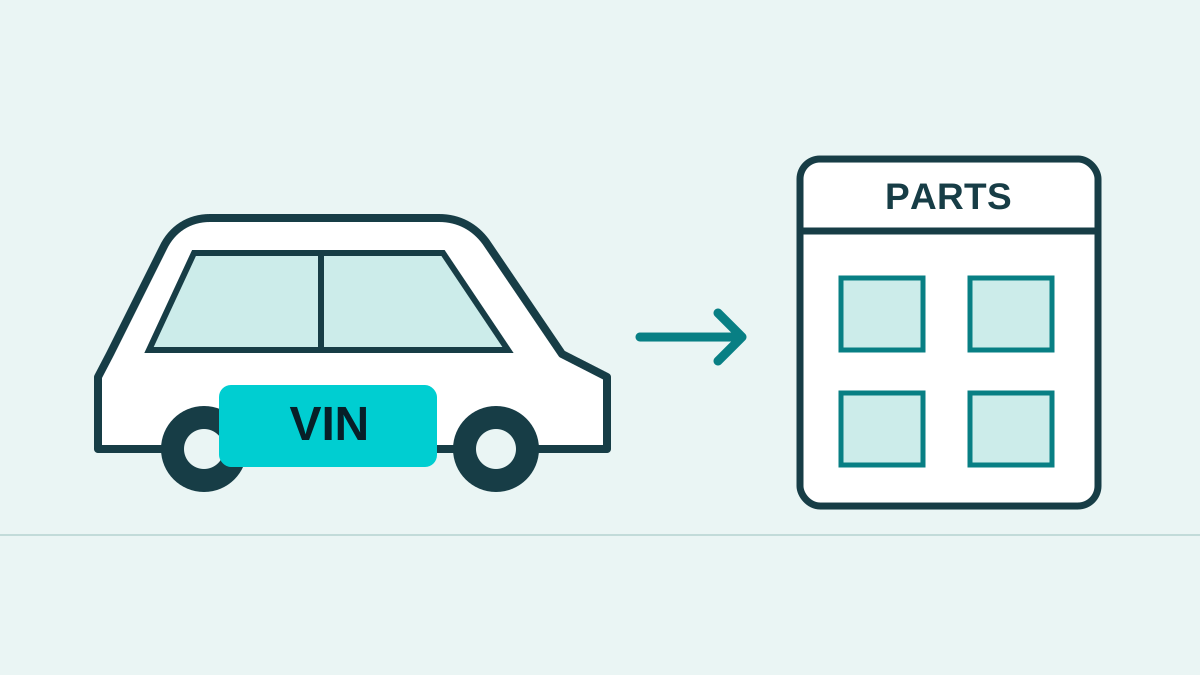
A customer provides the make, model and registration year, but the catalogue still lists several similar-looking parts. Before choosing one, a parts retailer or workshop needs to confirm that the search describes the right vehicle and that the conditions attached to the part have been checked.
The vehicle identification number, or VIN, helps identify the vehicle being searched. The results still depend on the database and catalogue details. A VIN starts the checking process; it does not confirm that every part shown is interchangeable.
Information to collect before searching
- The chassis number from the vehicle or its documents. Ask for a clear photograph and check the characters before entering them. Do not guess a character that is difficult to read.
- The vehicle details already known. These may include the engine, transmission or variant. Compare them with the search results.
- The part name and installation position. Identify front or rear, left or right, and the quantity needed, using the manufacturer’s position conventions.
- The number on the existing part and photographs, if available. Use these as supporting information, while checking whether the fitted part is correct for the vehicle.
For vehicles using a 17-character VIN, check that the full identifier has been entered. Where a vehicle uses a different chassis-number format, check the lookup method supported by the system rather than adding or removing characters to fit an input field.
Check three things before selecting a part number
Start with the vehicle details. Compare the result with the actual vehicle, especially details that affect the parts list. If information is missing or does not match, check the identifier and database coverage first.
Read the catalogue entry. Check the part name, installation position, diagram reference and entry notes. Similar appearance alone is not enough to select a part.
Check the number and application conditions. When several numbers appear, identify what distinguishes them and review any documented supersession. A relationship between two numbers does not establish interchangeability in every situation.
Is the registration year enough?
Registration year is convenient information for a customer to provide, but it should not replace production details and the full vehicle specification. If a catalogue distinguishes parts by production period, engine or variant, check those conditions with the catalogue or supplier before ordering.
If the selection remains uncertain, send the supplier the VIN, vehicle details, part photographs and candidate numbers together. This gives both sides the same information to review.
Keep a record for the next person handling the job
Before ordering, record the identifier used, part description, number, quantity, information source and any conditions affecting the selection. The sales team or technician can then trace how the number was selected.
For larger sets of lookup results and product records, see our guide to preparing parts data for catalogues and search.
VINLAZTIC is an online genuine parts catalogue with lookup by VIN or vehicle model. Visit the website and select its trial button to review the terms and register. Check the supported makes, models and data coverage before use.